Chapter 8
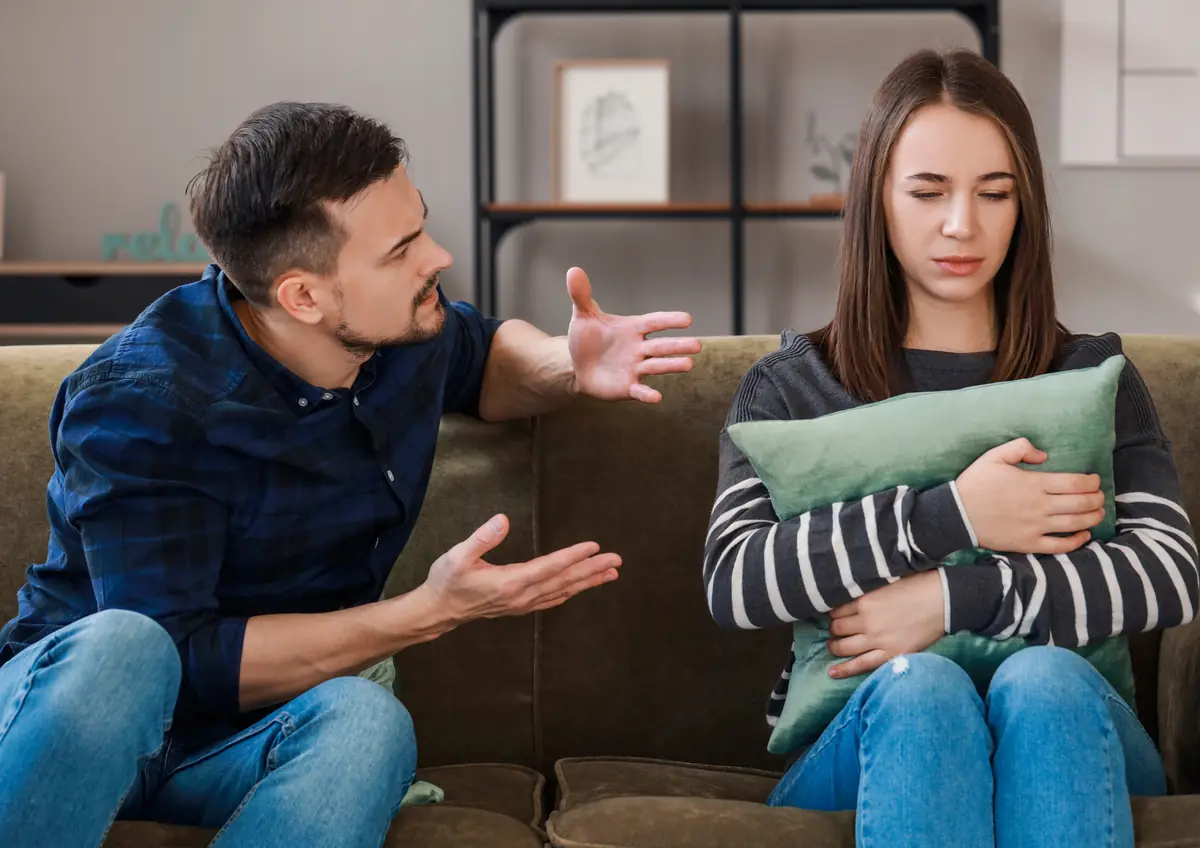
After a fight
How to reopen the conversation without a hollow apology and without starting round two.
A 3-text method to bring your partner back into the conversation, no “big talk,” no therapy, nothing that feels forced.
Our movie is on tonight, the one you always cry at
K
Thought about that burnt pizza in Lisbon today 😂
K
Found a photo of us from 2019 and smiled like an idiot
K
Watched you sleep this morning and didn't want to wake you
K
Why thirty texts a day can still mean zero conversation, and the three moves that change it.
Pick up your phone. Open the thread with the person you share a bed with. Scroll up a little.
If you're like most couples, you'll find exactly what's on the screen above: thirty, forty texts a day. And not one of them is an actual conversation.
It's not that the love is gone. It's not over. It's that somewhere along the way, the channel where you talk the most, your phone, turned into a bulletin board. Schedules, bills, kids, groceries. And when one of you tries something different, a joke, an “I miss you,” a little tease, the reply comes back flat, late, or not at all.
So that person gives up. And goes back to the grocery list.
If you've ever caught yourself thinking “we've become roommates,” this page was written for you. Read to the end. It takes seven minutes and it could change the next text you send tonight.
Everyone's heard it. Therapists say it, your best friend says it, the podcast says it: don't work things out over text, wait until you're face to face.
That makes sense for a fight. But look at the side effect: if everything that matters gets saved for “in person,” and in person is the couch at 10 PM with both of you exhausted… then what matters never happens.
Meanwhile, the channel that's open all day, where you're both actually present, gets reduced to “did you get milk?”
A couple's connection today is built or destroyed in eight-word messages, dozens of times a day. Not at the anniversary dinner. In the 2:37 PM text on a random Tuesday.
And most people send that text on autopilot.


Think about the last text you sent that got no reply, or got a “K.” We'd bet it started with information. A fact. A practical question. A request.
Information doesn't ask for an emotional response. It asks for a “K.” You got back exactly what you sent.
Now think about the last text that made you both laugh, or opened a real conversation. It didn't start with information. It started with attention: something you noticed, remembered, felt.
No message creates closeness if it starts with information.
The problem is, knowing the rule doesn't fix it. You need to know what to send, in what order, and what to do when the reply is “lol” or silence. That's what the method is for.
Looking back at what worked and what flopped in real conversations between people who love each other, we noticed that every exchange that brought a couple closer followed the same three moves. Always in this order. Never skipping a step.
A short text that proves you saw something specific about them, not a generic compliment, not an automatic “love you.” It's the text that makes them stop and read it twice.
A text that creates or brings back a reference only the two of you share: a memory, an inside joke, a small plan. This is the bridge itself.
A light invitation that's easy to say yes to and impossible to hear as a demand. Not “we need to talk.” A door they want to walk through.
Meeting ran late, home by 7:30
K
Need to stop at the store, we're out of coffee
Ok
Pulling in
👍
Meeting ran late, home by 7:30
1 · NoticeSaw you left this morning without the coffee I made you. One of those days from the start, huh?
Don't even. Didn't even see the coffee 😅
2 · BridgeJust remembered that Thursday in Lisbon when we ate sandwiches in bed because neither of us had energy for anything else
Haha best dinner of the whole trip
3 · Open DoorRerun tonight? I'm on sandwiches, you pick the movie.
Deal. Driving fast ❤️
Same Thursday. Same late meeting. Three texts of difference.
No sitting down on the couch to “have the talk,” nobody feeling accused. Notice that none of the three starts with information, and the last one is an invitation, not a demand.
In the book, each of the three moves gets a full chapter: the structure, the mistakes that cancel the effect (they're very common), and more than twenty examples you can adapt to your situation.
Get the 3 texts $47
It's not about writing well. It's about being seen again.
The Bridge works because it gives your partner back the rarest feeling in a long relationship: that someone is still paying attention.
Closer Words was created by a married couple: Luciene Felix, a psychologist, and Denver Felix, an artificial intelligence specialist. Luciene is the psychologist of the two; Denver is not a psychologist or a healthcare professional. Every chapter ends with a section signed by Luciene, a professional reading of the topic.
The method was born from a simple question we kept asking, first about our own thread after 27 years of marriage, then about the stories couples shared with us: why does the conversation between two people who love each other turn into a to-do list, and what changes on the rare occasions when it becomes a conversation again?
We looked for the pattern. We separated what reopened the conversation from what died on “K.” We tested it with couples willing to try. And slowly, the sequence we now call the 3-Text Bridge showed up.
It's not theory. It's a protocol anyone can follow, even if you're “not a words person.” The couples you'll meet in the book are fictional characters, and the conversations on this page are illustrative.
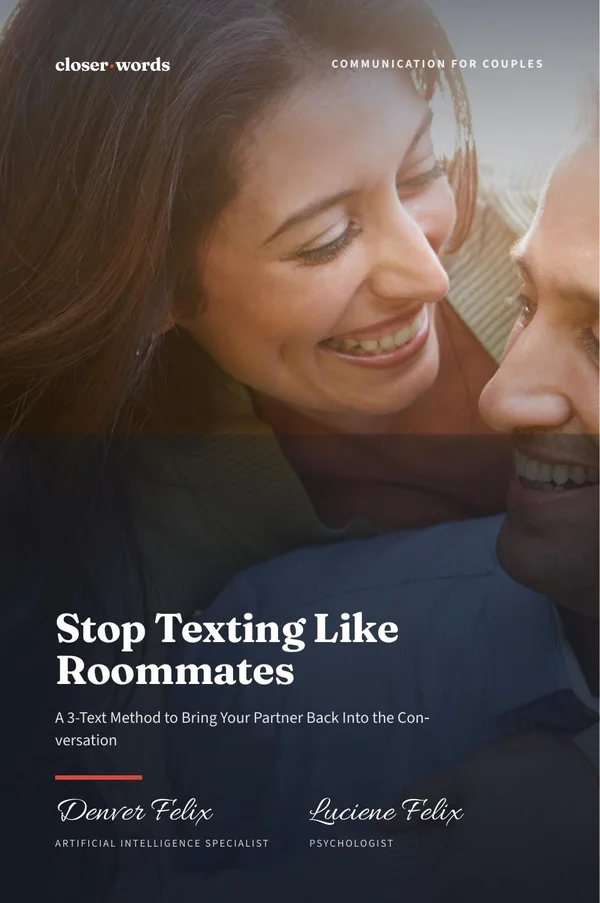
PDF + EPUB · a 2–3 hour read · instant access. Every chapter ends with a one-page summary and three ready-to-send texts.
How to reopen the conversation without a hollow apology and without starting round two.

Distance, busy seasons, and the habit of only talking about what needs to get done.

Flirting inside a long relationship, with class, and without sounding like you read a manual.
Ready-to-send texts organized by situation: morning, mid-workday, after an argument, forgotten anniversary, long distance, humor, desire. Copy, adapt, send.
A one-week plan: one text a day, what reply to expect, and what to do if nothing comes back. For anyone who wants a visible change by Sunday.
The 12 texts that kill connection, the “K,” the paragraph-vent, the disguised nag, sarcasm over text, and what to send instead of each one.
One couples-therapy session often runs $150 to $250. A “reconnection dinner” that ends in silence costs more than that, in money and in hope.
The complete ebook with all three bonuses is $47. It isn't cheap by accident. We want the barrier to be the decision to try, not the price.
One-time payment · Instant access · 60-day money-back guarantee
Secure checkout by ClickBank
Read the book. Use the Bridge for one week. If after 60 days you don't feel the conversation with your partner has changed, send one email and you get 100% back. No form, no explanation, no awkwardness.
The risk is all ours. Yours is to keep sending “did you get milk?”
That's exactly what it was designed for. The three texts don't depend on your partner wanting to “work on the relationship,” they depend on you changing what you send. There's a full chapter on when only one of you is moving, including the honest limit of what texting can do.
If you can send “home by 7,” you can send the three texts. The method exists precisely for people who aren't “good with words,” which is why there are 99 ready-made examples.
Both. The examples alternate who sends, him and her, and the method is the same. It works for long-distance relationships too.
No. It's educational material about everyday communication. Luciene Felix is a psychologist and co-author, but reading a book is not therapy and doesn't replace working with a professional who knows your history. It does not treat trauma, infidelity, or serious crises. If that's your situation, please see a professional, and the book says so in plain words.
Immediately. After payment you're taken to a download page with the ebook (PDF and EPUB) and the three bonuses, and you also receive the links by email. Works on phone, tablet, and computer.
60-day guarantee, full refund, no questions asked.
Probably about something practical. You can reply “K.” Or you can reply in a way that makes them stop, smile, and read it again. The difference between the two fits in three texts, and you can learn all three tonight.
Get the 3 texts $47 · 60-day guaranteeLuciene Felix and Denver Felix